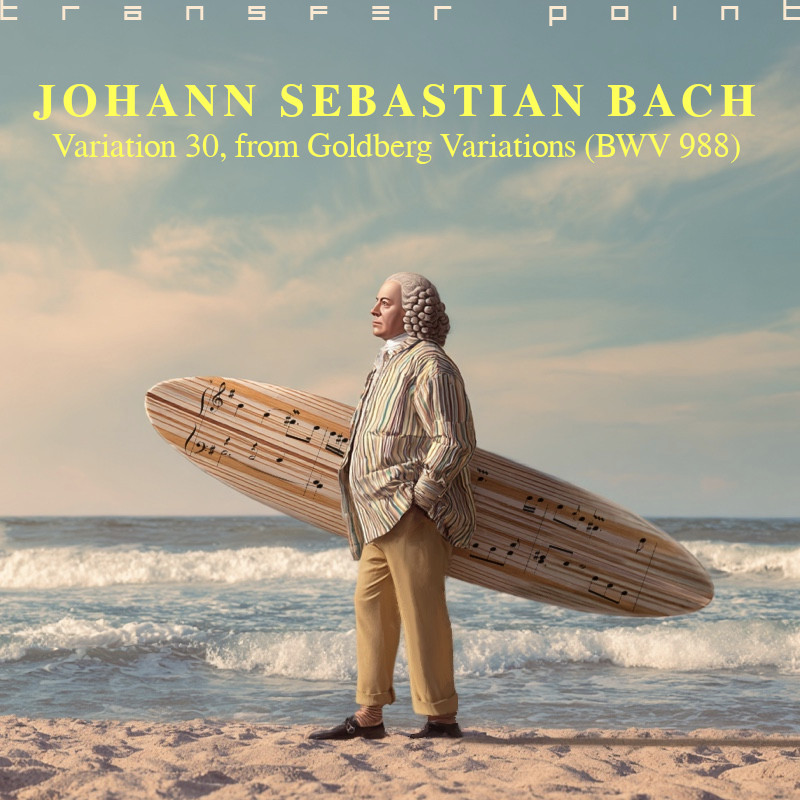
Music composed by Johann Sebastian Bach (1685-1750)
Alan Sanderson: guitars, bass, organ, additional percussion
Tom Sanderson: organ, e-piano, drums, tambourine
Alan’s Notes
I first heard the Goldberg Variations in the early summer of 1998 in England, when I bought a cassette tape of Pi-hsein Chen’s wonderful recording at a music store in Muswell Hill, north London. A week later I moved to Southend-On-Sea. Hearing the Goldberg Variations on piano often reminds me of my time in Southend. (I also love Glenn Gould’s very quirky second recording of them.)
The last Variation (#30, known as the “Quodlibet”) is my favorite. It introduces a new set of melodies to the chord progression and weaves them together in so many interesting ways. Music historians suppose that Variation 30 is meant as a musical joke. The Bach family often gathered together to sing and play music together.
“As soon as they were assembled a chorale was first struck up. From this devout beginning they proceeded to jokes which were frequently in strong contrast. That is, they then sang popular songs partly of comic and also partly of indecent content, all mixed together on the spur of the moment. … This kind of improvised harmonizing they called a Quodlibet, and not only could laugh over it quite whole-heartedly themselves, but also aroused just as hearty and irresistible laughter in all who heard them.”
According to the Wikipedia article (from which the previous quotation is also pulled):
A handwritten note found in a collector’s copy of the Clavier Ubung claims that Bach’s student, Johann Christian Kittel, identified two folk tunes making up Variation 30 by their first lines. Siegfried Dehn of the Prussian royal library later appended purported full texts to this note:
- Ich bin solang nicht bei dir g’west, ruck her, ruck her (“I have so long been away from you, come closer, come closer”) and
- Kraut und Rüben haben mich vertrieben, hätt mein’ Mutter Fleisch gekocht, wär ich länger blieben (“Cabbage and turnips have driven me away, had my mother cooked meat, I’d have opted to stay”), ascribed to the Bergamask theme
Inasmuch as this composition is a whimsical mashup anyway, I figured the old master wouldn’t mind a surf rock adaptation of his little masterpiece. This is the second Surf Bach recording we have done, and I definitely hope to do more. (The first one is here.)
My first attempt at an alternate arrangement for this piece was was performed at a memorial service 20 years ago to honor the people who had donated their bodies to the anatomy program at my medical school. (I didn’t know it at the time that the composition was a joke.) Two classmates joined me on this performance — one on clarinet, another on piano — and I played the nylon string guitar. I don’t have a recording of the performance, but here is an audio rendering of the score:
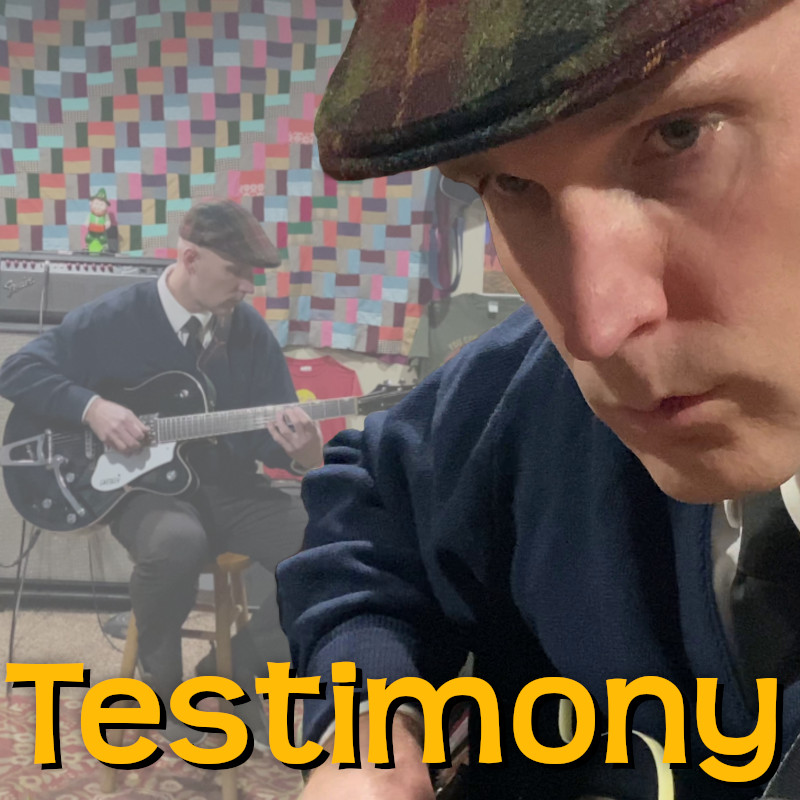
I appreciated Tom’s contribution to this recording. His drums and e-piano really hit the sound I was hoping for, and I dig the organ solo he came up with. Tom was also a good sport to indulge me in my idea for the music video.
It turns out that it’s a lot easier to make AI images of Bach with a surf board than it is to make a recording of his music with real instruments. The cover image was AI generated with some tweaks by Meesie Patch.
We are in Bach’s birthday season! I recently read an article by music critic (and political pundit — he frequently mixes the two) Jay Nordlinger that mentioned this:
“Johann Sebastian Bach has two birthdays, in a sense: yesterday (March 21) and March 31. The first birthday is in accordance with the Julian calendar, in use in Germany when Bach was born in 1685. The second birthday is in accordance with the Gregorian calendar.
“It requires at least two days to celebrate Bach. Plus another 363. Thank you for everything, JSB.”
Tom’s Notes
I feel intimidated by Bach. His wonderful compositions even sound good when played poorly. Perhaps they only sound simple because of the lack of large orchestration. His music is much more complex than my ears perceive. His modulations are symmetrical but I frequently took a wrong turn trying to play along with this piece.
Alan invited me to play on this one and I admit that nothing I contributed is contained in Bach’s notations – just me noodling about. Alan recorded most of the tracks at U-Turn studio. I recorded my parts at Pyramid Music Lab and contributed an improvised organ solo at U-Turn. It was a rewarding project and I am glad we took on another J.S. piece.

Info and Stats
- Production Dates: January — March 2026
- Equipment:
- Interfaces: Interfaces: Behringer Xenyx 1204USB, Behringer Ultra-DI DI400P, Tascam DSP24SD
- Keys: Roland FA-06, Conn Theatrette 552
- Guitars and Basses: Fender Squier Stratocaster, Ibanez AM53, Ibanez ASB140 bass
- Amplifiers and Speakers: Fender Dual showman, Fender Bassman 60, Fender 12×2 cabinet
- Microphones: Shure SM-57
- Software:
- Linux Mint 22.2
- Ardour 9.0.0
- Kdenlive 23.08.5
- x42 plugins: dynamic compressor, parametric equalizer, digital peak limiter, Red Zeppelin Drumkit
- Dragonfly Reverb: Room and Hall reverbs
- Linux Studio Plugins: Impulse Responses Mono
- Adventure Kid: AKIR Dual Springer
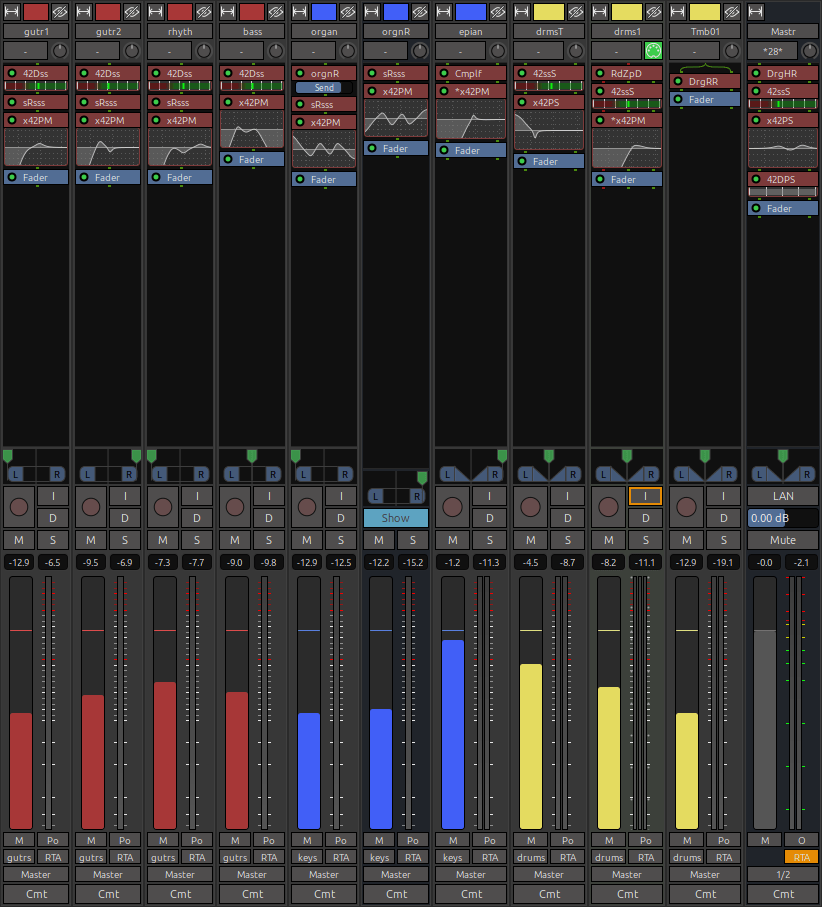
- Total Tracks and Busses: 10
- Guitars and basses: 4
- Organ: 2
- E-piano: 1
- Drums and percussion: 3

 Sanderson